Choosing a work briefcase is less about appearance than surviving daily friction. It may face crowded trains, office floors, rain, and hurried drops beside a desk. That is why many professionals ask, “what is the most durable material for a work briefcase”? Leather, ballistic nylon, canvas, and synthetic composites each handle wear differently. A material may resist abrasion yet fail at seams, handles, or overloaded corners. The strongest shell does not guarantee a dependable bag. Real durability depends on construction, maintenance, and the weight carried every day.
Hands-on inspections often reveal more than marketing labels. A full-grain leather briefcase can develop a rich patina, but moisture and neglect may leave permanent marks. Ballistic nylon usually handles scraping well and stays relatively light. Waxed canvas feels sturdy and can age attractively, although its coating may require care. Recycled polyester can offer practical weather resistance, but quality varies between manufacturers. Small details matter. Check reinforced stitching, metal hardware, padded laptop compartments, and smooth zippers. Open the bag fully. Notice whether the handle twists under pressure. I have found that a beautiful briefcase can still feel awkward after thirty minutes of walking. That detail is easy to overlook. This guide compares materials through durability, comfort, maintenance, weather resistance, and long-term value. It also questions the assumption that the most expensive option is automatically the most reliable. A balanced decision should match the briefcase to real work, not showroom expectations.
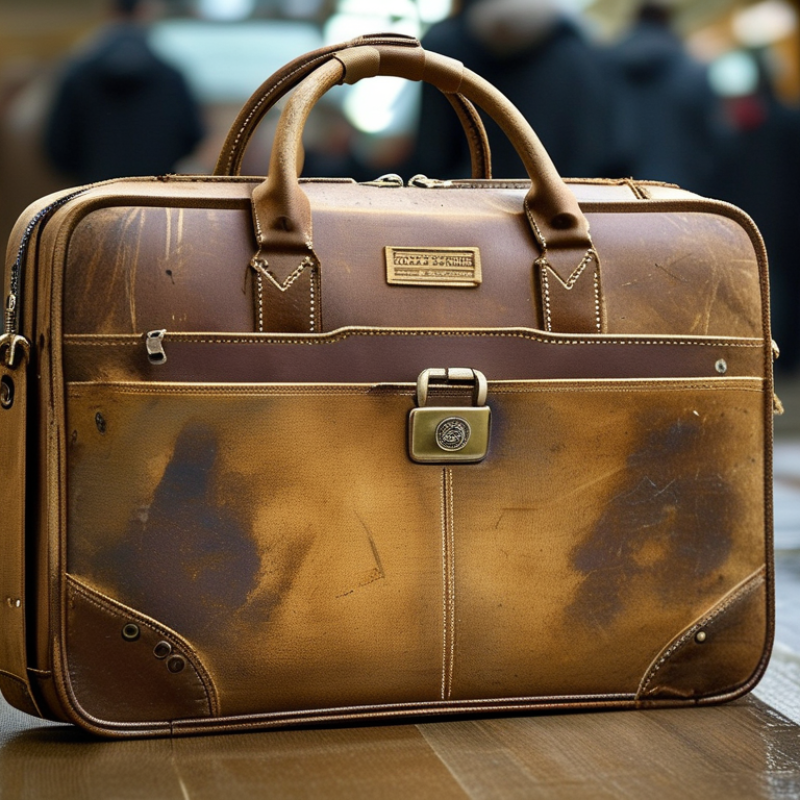
A durable work briefcase depends on more than its visible material. High-denier ballistic nylon often resists abrasion, light rain, and daily commuting better than ordinary fabric. Full-grain leather can age beautifully, but moisture, sharp edges, and poor conditioning may cause permanent marks. Polycarbonate offers strong impact protection, yet it can crack under concentrated pressure.
Test evidence matters. ASTM D3884 measures fabric abrasion under controlled wheel and load conditions, while ISO 12947 uses the Martindale method for repeated rubbing. Neither test predicts an exact service life. Real durability also depends on weave density, coating quality, seam construction, zipper strength, and handle attachment. Small details fail first.
Textile Exchange’s 2024 Materials Market Report recorded global fiber production at 124 million tonnes in 2023. That scale encourages material comparisons, but recycled content alone does not prove longer use. A tightly woven recycled nylon may outperform a loosely woven virgin fabric, though not always. Check denier, stitching, and tested abrasion results instead of trusting labels. Look closely. A thick shell can hide weak seams.
For leather, examine consistent grain, reinforced stress points, and edge finishing. For nylon, inspect bar-tacked handles and a water-resistant backing. A briefcase carried daily should also retain its shape without excessive weight. This is where material selection becomes imperfect: the strongest shell may be uncomfortable, while the most elegant option may need more care. Real-world durability is a balance between resistance, maintenance, load, and repeated handling.
| Material | Typical Construction | Abrasion Resistance | Water Resistance | Impact Protection | Typical Weight | Care Requirement | Overall Durability |
|---|---|---|---|---|---|---|---|
| Full-grain leather | Usually 1.2–2.0 mm thick, with the outer grain retained | High | Moderate after conditioning; not fully waterproof | High against compression and everyday knocks | 1.2–2.0 kg | Periodic conditioning; keep away from prolonged moisture | Excellent |
| Ballistic nylon | Dense woven nylon, commonly 840D–1680D | Very high | High when coated; seams and zippers may still leak | High; flexible fabric absorbs minor impacts | 0.8–1.4 kg | Low; wipe clean and inspect coating over time | Excellent |
| High-density nylon | Woven nylon, commonly 420D–1000D | High | Moderate to high, depending on coating | Moderate to high | 0.6–1.1 kg | Low; machine washing depends on lining and structure | Very Good |
| Waxed canvas | Heavy cotton canvas with a wax or oil-based finish | High | High initially; finish can wear at folds and contact points | Moderate | 0.9–1.5 kg | Spot clean; rewax when the surface becomes dry | Very Good |
| Polyester | Woven polyester, commonly 600D–1200D | Moderate to high | Moderate; improved by polyurethane or similar coatings | Moderate | 0.6–1.2 kg | Low; generally easy to wipe or wash | Good |
| Polypropylene hard shell | Molded thermoplastic shell, often with a separate fabric lining | High on the shell; scratches can be visible | Very high when the case is properly sealed | Very high; rigid structure protects contents | 1.4–2.4 kg | Low; clean with a damp cloth and mild detergent | Excellent |
| Aluminum alloy | Rigid metal panels with reinforced corners and a lined interior | High; surface may dent or scratch | Very high when fitted with a continuous seal | Excellent against crushing and sharp impacts | 2.0–3.5 kg | Low; remove oxidation or marks according to the finish | Excellent |
: Full-grain leather and high-denier nylon can last for years. Construction quality matters more than material alone. Poor stitching can ruin either option.
Leather resists tearing and develops a protective patina. However, rain, sharp corners, and weak conditioning may cause cracking. A fully loaded case also feels heavy.
Nylon is lightweight, flexible, and handles sudden rain well. Reinforced stitching improves its reliability. Thin nylon may lose shape around a laptop.
Dense canvas feels sturdy and holds its shape. Waxed canvas resists light moisture. Its coating may wear along repeated fold lines.
Check handle stitching, shoulder-strap anchors, padded corners, and exposed seams. Look for box stitching and extra fabric layers. Loose threads suggest rushed assembly.
The base absorbs repeated impact on desks and floors. Reinforced bottom panels improve support. Edge protection helps leather resist early wear.
Smooth metal hardware can support heavy use. Rough edges may cut fabric or scratch leather. An aluminum frame adds structure but increases weight.
No. Fabric ratings show abrasion resistance under testing. They cannot fully predict years of overloaded travel. My own judgment can still be wrong.
Avoid overloading the briefcase every day. Heavy laptops and documents strain seams and fasteners. A comfortable carry matters after several hours.
Choose leather for formal, long-term office use. Choose nylon for wet commutes. Choose dense canvas for rugged daily carrying. No option wins everywhere.
When considering what is the most durable material for a work briefcase, there is no single answer for every professional. Full-grain leather offers excellent resistance to abrasion and can become more attractive with age, while ballistic nylon is lightweight, water-resistant, and well suited to frequent commuting. Heavy-duty canvas provides a balance of flexibility, strength, and a more relaxed appearance. The best choice depends on exposure to weather, daily handling, travel demands, and the amount of weight the briefcase must carry.
Material alone does not determine longevity. Reinforced stitching, strong zippers, durable handles, protected corners, and a well-supported structure are equally important. A briefcase used in a formal office may benefit from carefully maintained leather, while nylon or canvas may perform better in crowded transit or unpredictable weather. Regular cleaning, prompt drying, careful weight distribution, and occasional conditioning can prevent premature wear and extend the bag’s useful life. Ultimately, the most durable briefcase is one whose material and construction match the user’s environment and maintenance habits.

 Ripped Fashion